

The Algorithm Knows I’m Sad
What it means to be known by something that cannot actually know you.

It started, as most unsettling realisations do, on a Tuesday evening with nothing particularly wrong. I was scrolling through Instagram, the specific kind of scrolling that is not really looking for anything, just filling the container of a quiet hour, when I noticed that my feed had shifted. Not dramatically. But the content had softened, gone inward. There were more journal prompts than usual. More videos about grief and its timelines, about the loneliness of ambition, about the strange isolation that can live inside a full and functional life. Someone I had never heard of was speaking directly to a camera about the particular sadness of wanting more than you can currently reach, and I watched the whole thing, which is to say I held still for four minutes on a Tuesday for a stranger who had, without my permission, identified something I had not yet named.
I had not posted anything sad. I had not searched for anything sad. I had simply been, for a few weeks, quietly sad, in the ordinary, low-grade way that does not require intervention but does change the quality of an evening. And the algorithm knew. Or rather, it had inferred. It had read the pauses, the lingering, the three-second hesitation before scrolling past a certain kind of content, and it had drawn a conclusion about my interior life that was, uncomfortably, correct.
This is the thing about living digitally that we have not quite developed the language for yet. The platforms do not just reflect us. They read us. And the reading is, in its way, more intimate than most of what passes for intimacy in ordinary life.
There is a word in Japanese, amae, that roughly translates to a kind of presumptuous dependence, the emotional state of leaning on another’s indulgence, of feeling comfortable enough to be fully oneself without the usual social performance. Psychologists use it to describe a specific quality of closeness, the kind where you do not have to explain yourself because the other person already understands the shape of you. It is, by most accounts, one of the more profound forms of human connection.
I have been thinking about amae in relation to the algorithm because what the feed offers is a strange, synthetic version of exactly that. It knows your shape. Not because it cares, not because it has invested in your story or sat with you through anything, but because it has processed enough of your behaviour to build a working model of your emotional state. It gives you what you seem to need before you have consciously identified the need. And in doing so, it mimics something that used to require years and trust and proximity to achieve.
The question I keep arriving at is not whether this is good or bad, which is the question the think-pieces ask, exhaustingly, in every direction. The question is what it does to us. What happens to a person who is emotionally understood, consistently and accurately, by something that experiences nothing in return?
“The algorithm does not know you. It knows your pattern. And in the absence of people who know the difference, the pattern starts to feel like enough.”
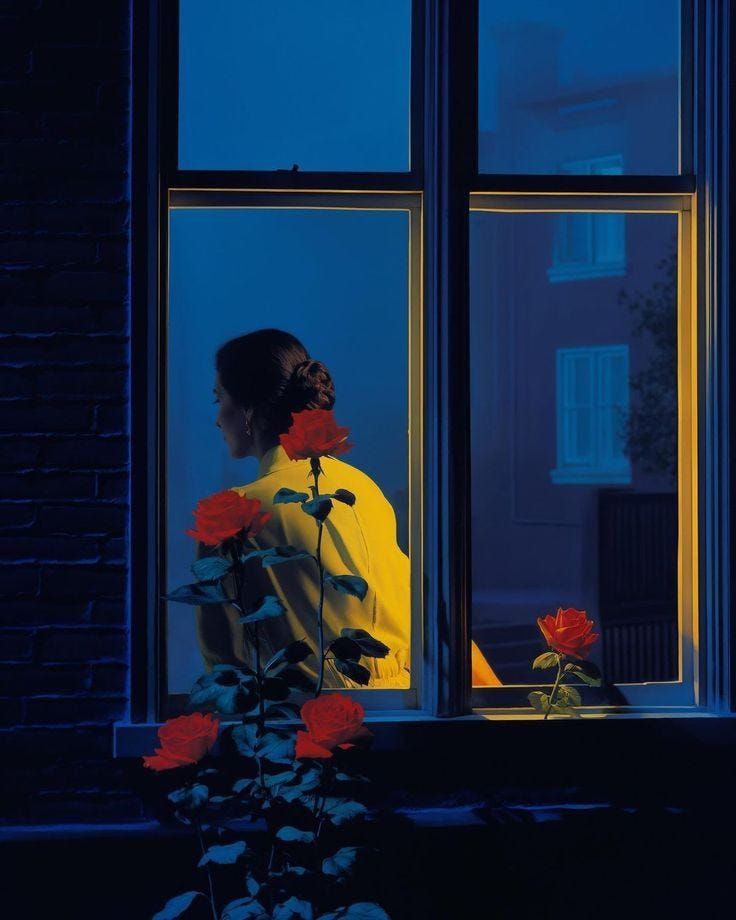
I want to be honest about how good it feels. That is the part that gets left out of the discourse, which tends to frame algorithmic intimacy as either a conspiracy or a tragedy, and rarely as what it also is: genuinely, embarrassingly comforting. On the evenings when I am tired in a way I cannot explain to the people around me, when the loneliness is specific and not easily shared, the feed arrives pre-tuned. Someone is talking about exactly the thing I am feeling. The comments are full of people saying this, which is the internet’s shorthand for: you have named something I was carrying alone. There is a warmth in that. A specific, reliable warmth that asks nothing of me and arrives on demand.
The problem is not the warmth itself. The problem is the way it can begin to substitute for the harder, slower, more reciprocal warmth of actual human closeness. Real intimacy requires disclosure: the risk of saying the thing out loud to a person who might respond poorly, who might not understand, who brings their own needs and blindspots and bad days into the exchange. The algorithm has none of that friction. It receives everything and gives back only what is useful. It is intimacy with the difficulty removed, and the difficulty, it turns out, is not incidental to what makes intimacy real.
There is a particular kind of loneliness that digital life has produced that is distinct from older forms. It is not the loneliness of isolation, of having no one. It is the loneliness of being surrounded by connection that does not quite land. Of spending an evening in the presence of hundreds of pieces of content made by real people expressing real things, and still going to sleep feeling essentially unknown. Sherry Turkle, the MIT researcher who has spent decades studying humans and technology, called this being “alone together”: the paradox of feeling most isolated precisely when the apparatus of connection is most available.
What she identified in her research, and what I recognise in my own life, is that the platforms have changed not just how we communicate but what we expect communication to feel like. We have become accustomed to responses that are fast, frictionless, and affirming. Content that meets us where we are. Interactions that cost very little. And the more accustomed we become to that register, the more demanding real human exchange begins to feel by comparison. The friend who does not text back quickly enough. The conversation that requires energy you do not currently have. The relationship that asks you to be present in ways that the feed never does.
I do not think we are becoming incapable of real intimacy. I think we are becoming unused to its texture. There is a difference, but it is a difference worth paying attention to.
The curation of emotion online is its own separate phenomenon, and it runs alongside algorithmic intimacy without being the same thing. What we post about how we feel is not the same as what we feel. Most of us understand this abstractly. What is harder to understand is the degree to which the performance of an emotion, done publicly and repeatedly, begins to shape the emotion itself.
There is research in psychology on what is called emotional labour, the management of feeling as a form of work, originally studied in professional contexts but now clearly applicable to the self-presentation demands of social media. When you caption a difficult experience with language that frames it as growth, when you post about grief in a way that is also, necessarily, aesthetically considered, when you share the sad thing in the way the platform rewards, you are not just communicating. You are also, subtly, being asked to process your feelings in a format that the audience can engage with. And that process, over time, can make it difficult to locate what you actually feel underneath the version of it you have learned to perform.
I have caught myself, more than once, reaching for my phone in the middle of an experience, not to capture it but to begin translating it. To find the sentence that would make it legible. And in that moment, the experience itself goes slightly elsewhere, becomes slightly less mine, becomes instead the raw material for something I will later make public. This is a small thing. But it is a thing that happens constantly, and I am not sure we have accounted for what it costs.
“The algorithm does not cause loneliness. It finds it. And then it makes itself comfortable there, in the exact shape of what was already missing.”
What I keep returning to is a question about witness. What does it mean to be witnessed? Not seen, which is a much lower bar, the bar the internet clears easily. But witnessed: known over time, in context, with the full weight of your history and your contradictions and your worst weeks and your ordinary ones. This is what the people who love you are supposed to offer, and what they sometimes do, and what is genuinely irreplaceable when they manage it.
The algorithm offers something that resembles witnessing at a distance. It tracks you over time. It builds a model of your patterns. In some ways, it is more consistent than the people around you, more reliably attentive to the signals you put out. But it does not carry what you have given it into any relationship. It does not think about you when you are not there. It does not notice your absence. The data exists, but there is no one home behind it, and at some level the body knows the difference, even when the mind is willing to find comfort in the substitution.
I think this is why the Tuesday evening unsettled me. Not because the algorithm was wrong. Because it was right, and the rightness felt lonely in a way I had not anticipated. To be accurately read by something that cannot know you is a specific modern experience for which we do not yet have a fully adequate vocabulary. It is not quite surveillance and not quite care. It sits somewhere between them, in a space that did not exist before, and that we are all, in our different ways, still learning to navigate.
I still use the app. Of course I do. That Tuesday I watched another video, and then another, and eventually went to sleep feeling the particular flatness that comes after a long time spent in digital company. The feed had known I was sad. It had responded accordingly. And I had let it, because it was easier than the alternative, which was to close the phone and sit with the thing that the algorithm had correctly identified and that I had not yet told anyone about.
There is something in that choice, made on a Tuesday, that feels like it says more about this moment than most of the discourse around it. We are not passive victims of the technology. We are people who keep reaching for it, again and again, because what it offers is real, even when it is not enough. The question is not how to stop. The question is what we are quietly hoping the feed will eventually give us that it is structurally incapable of providing.
And whether, in the meantime, we are still telling the people around us the things we are only showing the algorithm.
Wow, I never thought about it like that. Thanks for this!
loved reading this! coincidentally i'm also working on a piece about algorithms - absolutely loved your take on the loneliness/connection aspect of it :)